
Indiana’s investment in City Connects is paying off. In the state’s City Connects schools, absences are down, reading and math scores are up, and achievement gaps are closing.
City Connects launched in Indiana in 2021 with the help of Learning Loss Recovery funds intended to support students in the wake of the COVID-19 school closures. Through a partnership between the Marian University Center for Vibrant Schools and the Boston College Center for Thriving Children, City Connects spread to more than 40 public, private, community, and charter schools throughout Indiana.
With the Indiana Legislature looking to understand the impact of this investment, Joan Wasser Gish—Director of Systemic Impact at Center for Thriving Children—and Jillian Lain—Executive Director of Integrated Student Support and Center Strategy at the Center for Vibrant Schools—appeared before the Legislature’s Interim Study Committee on Education.
In her Oct. 14 testimony, Wasser Gish shared new research that found students in City Connect schools scored higher on Indiana’s statewide assessments (ILEARN) than students in schools without City Connects. The difference was about 0.06 standard deviations in Math and 0.02 standard deviations in ELA. These Math gains are equivalent to approximately 36 days of in-school learning. The gains were even more significant for Black students.
Researchers also found that compared to their peers in other schools, City Connects students are experiencing a 13% reduction in absenteeism and are 2.5 percentage points less likely to be chronically absent. That translates to about 250 more students in a district of 10,000 staying connected to school and learning throughout the year. This impact was even more notable for students eligible for free or reduced-price lunch, who are over 3 percentage points less likely to be chronically absent.
“To be able to demonstrate that bringing in City Connects had a transformative effect on the learning outcomes of students, especially low-income and Black students, is really important for those students and everyone who cares about their future success. It’s also important for the state. Indiana is demonstrating the capacity to identify scalable, evidence-based approaches, to hold those approaches accountable for improving outcomes, and, most importantly, is seeing positive results for students,” said Wasser Gish.
In her testimony, Wasser Gish explained that by connecting students with services in the community, increasing enrollment, and improving teacher retention, the benefits of City Connects outweigh the costs.
“City Connects builds on existing personnel, programs, and practices in schools and the surrounding community to create a more effective and efficient system of support around each student,” said Wasser Gish. “The Center for Benefit-Cost Studies in Education at the University of Pennsylvania finds that, if City Connects were implemented widely, taxpayers would triple the beneficial impacts of what we already spend on education, social services, health and mental health services, and youth development opportunities.”
The research on City Connects in Indiana is supported by a grant from the Institute of Education Sciences, U.S. Department of Education, and conducted in partnership with the Indiana Department of Education.
“The state of Indiana has been a wonderful partner in sharing data and helping to identify questions that matter to local decisionmakers. The partnership has been foundational to this work, showing how states can pair the expansion of City Connects, an evidence-based approach in student support, with rigorous research and continued learning about student outcomes,” said Wasser Gish.
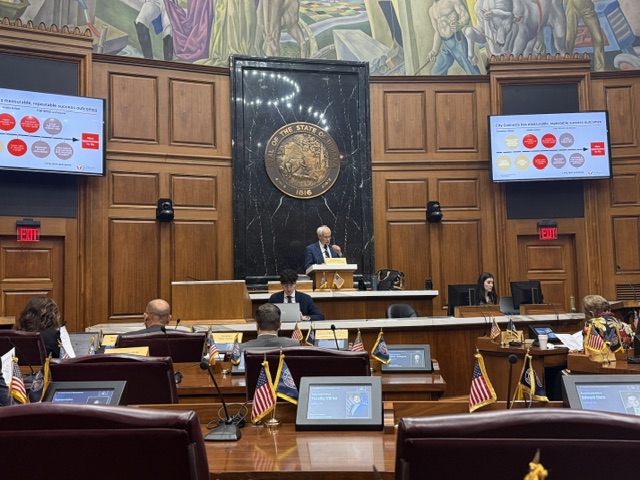
In her testimony, Lain shared details of the City Connects implementation in Indiana, highlighting the critical support and enrichment opportunities that came from strong community partnerships. She explained that across the multi-year implementation, schools partnered with an average of 572 programs provided by community agencies each year. Between community partners and City Connects Site Coordinators, they were able to deliver more than 109,000 services to students.
“What makes City Connects unique is that every child can benefit—not just the students in need of crisis intervention,” said Lain in her testimony. “Through the implementation of City Connects, schools have leveraged student needs and strengths data to identify meaningful opportunities that connect learning to real-world experiences.”

She shared examples of how City Connects has helped schools transform data into action by mobilizing community partnerships, like a lifeguard certification through the YMCA resulting in summer employment with the local Parks Department, giving students workforce skills, confidence, and career exposure.
“The impact of City Connects demonstrates what is possible when schools are equipped with a proven framework to systematically identify student strengths and needs, leverage community partnerships, and ensure every child has access to opportunities that support their success,” Lain said in her testimony. “The Learning Loss Grant investment has not only addressed the challenges students faced following the pandemic but has also established sustainable systems that continue to benefit children across urban, rural, traditional public, charter, and nonpublic schools.”