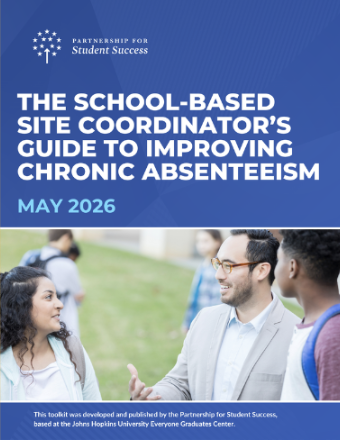
A new toolkit by the Partnership for Student Success highlights City Connects as an effective approach to reducing chronic absenteeism. The toolkit, The School-Based Site Coordinators Guide to Improving Absenteeism, aims to give schools information, resources, and tools to understand and address the barriers to attendance in their communities.
“One of the most important things we do at the Center for Thriving Children is share what we're learning from both practice and research. The opportunity to work with the Partnership for Student Success and contribute to their toolkit is a wonderful avenue to share what we're learning through City Connects implementation with this broad national audience,” said Joan Wasser Gish, Director of Systemic Impact at the Mary E. Walsh Center for Thriving Children.
Chronic absenteeism—when a student misses 10% or more of the school year—has remained high since the start of the pandemic, with nearly half the nation’s K-12 students attending schools where at least 20% of students are chronically absent.
“This toolkit highlights ways for schools to think strategically about what students need to be able to attend school, and to create an environment where students want to attend school. City Connects provides a really concrete illustration of how those ideas can be implemented effectively. And being able to provide that example can shift people's expectations of what's possible for students,” said Wasser Gish.
City Connects’ evidence-based approach to integrated student support focuses on addressing the needs and fostering the strengths of students, families, and communities. City Connects Coordinators work with school staff to understand the unique challenges facing each individual student and connect them with school-based or community resources to address those needs.
“City Connects is designed to understand the root cause of challenges students are facing. There are a lot of different reasons why a student may be absent from school. City Connects enables schools to unpack that and to really understand what the barriers to attendance are for each individual child and their family,” said Wasser Gish.
City Connects also helps schools discover what makes students excited to come to school. Through student surveys and collaboration with school staff, Coordinators identify students’ interests and work to create relevant enrichment opportunities.
“If a child knows that if they come to school they get to go to their favorite club, or be part of a theater group, or go to art class, or see their coach, or connect with their friends, that can make all the difference. Kids become self-motivated to come to school for a positive experience,” said Wasser Gish.
A recent study found that students in City Connects schools report more frequent chances to collaborate with peers, help others, and contribute to the school community. They also describe teachers as more likely to notice their efforts, offer encouragement, and express care. In addition, City Connects students reported more supportive friendships, a stronger sense of belonging in school, and were more likely to report that they enjoyed attending school and believed that education was valuable and worth their effort.
“These ways of connecting shape a student's experience and contribute to whether or not they want to come to school,” said Wasser Gish.
City Connects’ multi-pronged approach to support the whole child is reducing chronic absenteeism. Students who attended City Connects schools in elementary school are significantly less likely to be chronically absent than students who never attended City Connects schools. Preliminary findings from a study of schools in Indiana indicate that students in City Connects schools are 7% less likely to be chronically absent.
“City Connects creates an infrastructure that enacts best practices in a very intentional, organized, systematic way to ensure no child is falling through the cracks. This broad, whole-child perspective allows schools to simultaneously address root cause and lower barriers, and hone in on student interest and engagement to help make school a positive experience. It's that combination of head and heart that allows for City Connects to be so effective at reducing chronic absenteeism,” said Wasser Gish.