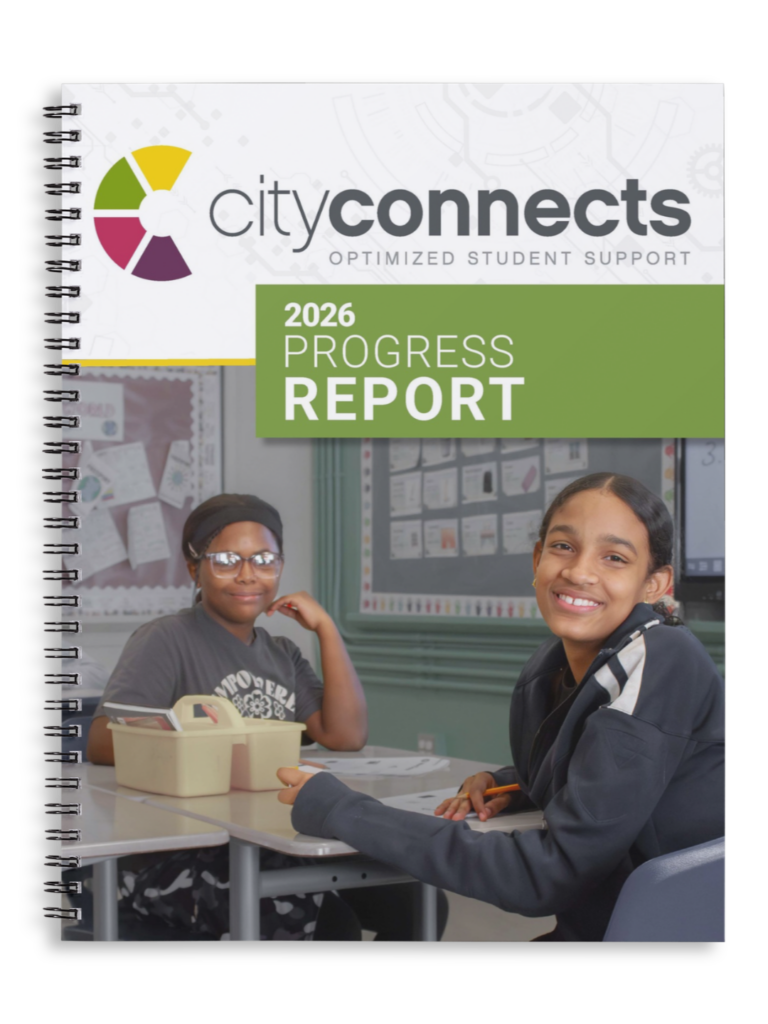
This week City Connects released its biennial Progress Report, highlighting its continued impact on students and families across the United States and Ireland. The report features new evidence demonstrating City Connects’ positive influence on student engagement, enrollment in public schools, and outcomes for students in turnaround schools. The report also shares updates on City Connects’ continued growth into new and unique settings.
“Increasingly, schools and districts are seeking effective ways of addressing the out-of-school factors that influence students’ thriving in school. City Connects offers an example of an effective practice that makes a difference in students’ lives, both in school and beyond,” the report reads.
City Connects is now serving thousands of students in public, charter, private, and Catholic schools across nearly 30 U.S. cities and towns and in 18 schools in Dublin. In City Connects schools overall, 19% of students are English Language Learners, 77% are students of color, 20% are students with disabilities, and 70% are students experiencing economic disadvantage.
“For children living in poverty, out-of-school challenges can be pervasive and severe, impeding their academic success and ability to thrive in school and in life,” the report says. “In order to ensure that all students can achieve and thrive, schools need a systemic approach to addressing out-of-school disadvantage.”
City Connects is that approach. By addressing the needs and fostering the strengths of each student, this unique model of integrated student support is having a long-term, positive impact on students. Evidence highlighted in the Progress Report shows that students in City Connects schools have:
- Stronger academic effort and behavior
- Higher report card scores
- Higher attendance
- Higher performance on statewide tests
- Higher academic achievement
The evidence also shows that City Connects students are:
- Less likely to repeat a grade
- Less likely to be chronically absent
- Less likely to drop out of high school
- More likely to enroll in, and graduate from, postsecondary institutions
New evidence finds that City Connects also increases enrollment in traditional public schools, a critical finding as schools across the nation battle declining enrollment due, in part, to students opting to attend charter or private schools. A new study released in the Progress Report compares public schools in Massachusetts that have implemented City Connects to schools with similar enrollment trajectories that have not adopted City Connects. Researchers found that City Connects schools had a 6-8% increase in enrollment, which translates to an average of 15-20 additional students—a gain that could generate an estimated $300,000-$375,000 in additional annual revenue for schools.
Another study featured in the Progress Report finds measurable learning gains when turnaround schools implement City Connects. Turnaround schools—schools that are designated as persistently underperforming—often undergo interventions like restructuring school operations, replacing leadership and staff, or implementing new instructional practices. These efforts have not always been successful, in part because they overlook out-of-school factors that significantly impact student learning like food insecurity, inadequate healthcare, or unstable housing. By looking at outcomes from Springfield Public Schools in Massachusetts—where some underperforming schools adopted City Connects and others did not—researchers found evidence that implementing City Connects during the school turnaround process led to significant improvements in student academic performance. Schools that adopted City Connects showed an increase of 0.163 standard deviations in math and 0.139 standard deviations in English Language Arts. These gains correspond to increases in learning typically associated with at least one-third of a full year of in-school instruction.
A third new study finds that City Connects enhances students’ attitudes toward school. Researchers found that students in City Connects schools reported higher levels of prosocial opportunities, perceiving more frequent chances to collaborate with peers, help others, and contribute to the school community. They also reported stronger teacher recognition, describing teachers as more likely to notice their efforts, offer encouragement, and express care. In addition, City Connects students reported greater peer affiliation, indicating more supportive friendships and a stronger sense of belonging within their school environment. Most notably, City Connects students were more likely to report that they enjoyed attending school and believed that education was valuable and worth their effort.
A new case study featured in the Progress Report looks at how the City Connects model has been adapted to work in its first rural community. By studying the successful implementation of City Connects in Shakamak, Indiana, researchers found that the City Connects framework is flexible enough to adapt to different local contexts and can address many of the educational inequities experienced in rural contexts by leveraging the strengths of the community.
In addition to offering an update on City Connects’ impact, the Progress Report serves as an opportunity to honor the hard work and dedication of the more than 150 City Connects Coordinators as well as dozens of Program Managers, implementation partners, and the Center for Thriving Children staff.
“In a time where supporting the whole child is more critical than ever, we are deeply grateful for all you do to connect children and families to the supports, services, and enrichment opportunities they need to thrive,” Mary E. Walsh, Executive Director of City Connects, and Eric Dearing, Executive Director of the Center for Thriving Children, said in a letter introducing the Progress Report. “Thank you to each and every person who makes this work possible. City Connects makes a difference to children, and your support makes a difference to us.”
Check out the full progress report to learn more.