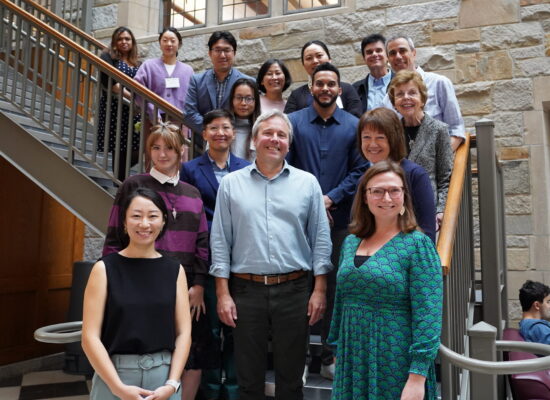
The Mary E. Walsh Center for Thriving Children, home to City Connects, is growing — and inaugurating a new leadership structure — in order to expand its capacity for research, outreach, and innovation.
Expanded Leadership
Mary E. Walsh, who launched the Center and who served as its executive director, takes on the new role of Founding Director as well as being a Senior Fellow at the Center. Walsh will also continue her work as the Executive Director of City Connects.
Eric Dearing, a professor of Applied Developmental Psychology in Boston College’s Lynch School of Education and Human Development, is the Center’s new Executive Director.
Claire Foley will serve as the Center’s Associate Director, and she will continue to serve as the Associate Director for City Connects.
“Eric, Claire, and Mary make an outstanding leadership team, and they have already developed a compelling vision for achieving even greater impact through the Center’s work,” Lynch School Dean Stanton E.F. Wortham tells the Boston College Chronicle.
Growing Research Efforts
As the new executive director, Dearing is excited about building on the Center’s years of progress.
“City Connects is an incredible program that affects thousands of children’s lives in positive ways every day,” he says, “and we want to grow that. We see a chance to do that by supporting the work of all the experts and professionals who do the work of City Connects.
“We’re bringing in more research on integrated student support and on how children, families, communities, and schools are trying to thrive in a very inequitable world.”
“Some of this new research I define as understanding harm and hope in the context of poverty. This is basic developmental psychological research that helps us understand precisely how poverty undermines children and families and communities — and precisely how we can offer solutions. What are the ways that even in the context of economic deprivation children, families, and communities can thrive?”
Expanding policy research
Dearing says that even if economic policies can’t be changed to address poverty there are other levers.
“I connected to Mary in the first place because we were both looking at systemic disadvantages. Whether it’s racism or other forms of marginalization and oppression we’re going to need systemic solutions.”
Dearing’s research in this area looks at how policy changes like establishing universal preschool or family leave programs can impact children and families, especially those at the lower end of the income spectrum.
Much of Dearing’s work is international, which creates an opportunity to look at both policies and their political and national contexts.
Dearing also plans to weave research on early math into the center’s work through DREME — which stands for Development and Research in Early Mathematics Education — a network of “scholars and researchers from a variety of disciplines” who are collaborating to “promote young children’s early math development.”
Stronger Research/Practice Partnership
Another key part of the Center’s new vision is forming a tighter bond between the City Connects Coordinators who deliver integrated student support and researchers who study this approach.
“We see a chance to build up the City Connects practice, but also to do something bigger, which is to build our understanding of how we can better help children thrive in the middle of inequity,” Dearing says.
This could mean everything from small panel discussions to national gatherings where City Connects Coordinators can have more conversations with academic researchers. This kind of communication is essential for the ongoing continuous improvement process that enables City Connects to be on the leading edge and reach more students across the country.
A new field
As its efforts grow, the Center will also be thinking long term about how to turn integrated student support into part of the professional field of education.
“We’re not quite at a place where people recognize this as a field from a research standpoint or from a practice standpoint, but we’re getting there,” Dearing says, adding:
“We’re thinking about what it would mean if education schools trained teachers, social workers, and school counselors to specialize in student support. And, we hope to welcome more researchers into this area of study”
“The potential to change training could change the systems that support professionals who go into this field. This is something the Center has made great strides on. If we can continue to build on this, then when state education departments are thinking about, What’s next? How do we get education where we want it to be? one of the tools in their toolkit could be integrated student support.”
Looking Forward
Future success for the Center, Dearing says, will likely come in multiple forms. More children in more cities and states will get the integrated student support they need to thrive. More school professionals will know about integrated student support and more of them will have the support they need to do this work more effectively. And there will be a larger, more dynamic intellectual community that generates new ideas and innovations.
“We can imagine a world where we wouldn’t be asking if we need integrated student support because it would be a given,” Dearing says, “and we’d only be asking how we could set up the best systems of support. That would be a game changer.”