It’s the first anniversary of the National Guidelines for Integrated Student Support, and we’re excited to report that they are helping educators design customized – and, in some cases, strikingly original – systems to promote students’ success.
Released by the Mary E. Walsh Center for Thriving Children, the National Guidelines were co-created by a national working group of experts who drew on best practices. The guidelines have been shared by the National Governors Association and by the White House’s National Partnership for Student Success.
“One epiphany we had in developing the guidelines is that evidence-based approaches are using different mechanisms to achieve the same core functions that promote student success,” Joan Wasser Gish, the Center’s Director of Systemic Impact, says.
The common features that are in the National Guidelines are:
• conducting a holistic review of each student that focuses on strengths and needs
• developing an individualized plan for providing each student with in-school and community-based services and opportunities
• following up on those plans, and
• using data to inform decisions at the classroom level, the school level, and the community level
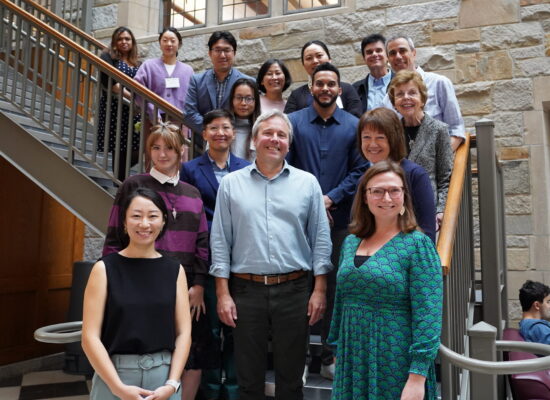
One promising, practical use of the National Guidelines is at the Systemic Student Support (S3) Academy — a joint project of the Massachusetts Department of Elementary and Secondary Education, the Rennie Center, and the Center for Thriving Children.
At S3, educators have the time and guidance they need to design their own systems of student support, using the National Guidelines as a roadmap and a tool for self-assessment.
One example is work being done by educators from Nipmuc Regional High School in Massachusetts’ Mendon-Upton School District..
Through the best practices offered by the National Guidelines, Nipmuc Regional High School is working on a project to center students’ voices.
“Their vision of the school is that students will arrive as freshmen with an impression of themselves,” Jen Bouckaert, Senior Manager of Coaching and Networks at the Center for Thriving Children, says.
“And then, four years later, the school would help students look back and understand how they have changed and developed over four years of high school. So when students graduate, they will take that self-knowledge with them. It’s a different approach to student support.”
Nimpuc’s principal John Clements explains that “S3 has the potential to provide a formal way to make sure that students do not fall through the cracks.” He says S3 also provides “a plan/tool that helps us to get to know what students need, what their interests are, how to customize learning for those interests, and how to build connections with the students and their families. It’s a way to work toward making sure students are known, valued, and celebrated.”
Mendon-Upton district leaders are also developing student data protocols and working with an outside vendor to develop a consolidated data system.
Echoing Clements, Bouckaert adds, “The core principle is to develop a holistic understanding of students. But the great thing about S3 Academy and the National Guidelines is that each school can use them in their own way. And having this kind of home-grown system increases the chance that the system will be sustainable, that it will outlast any personnel changes.”
Another example is the work being done by educators from Monson, Mass., who are also participating in the S3 Academy and using the National Guidelines. Two Monson schools that share the same principal have assembled a team of counselors and behavioral health specialists who have done whole-grade reviews to assess students’ needs.
Although the S3 projects vary among schools and by grade level, they all show how schools can use the National Guidelines to develop a vision and act on it.
“Monson’s counselors function as coordinators, and the counselors are working with teachers to develop student plans,” Bouckaert says. “Their principal knows that teachers need time, so he’s giving them time, and he knows that the counselors need data, so he’s making data available.”
“The plans that are created will follow students into the new school year and go to their new teachers. And the counselors will do a new review to understand what new services students may need and what new strengths they have.”
Although the S3 projects vary among schools and by grade level, they all show how schools can use the National Guidelines to develop a vision and act on it.
Wasser Gish says there are additional benefits. “The work being done at S3 Academy teaches us what schools actually need to implement the National Guidelines’ best practices, and it will enable the Center for Thriving Children to help the entire field to make progress toward not just defining and understanding best practices, but also implementing them so that students receive better support.”
“The guidelines can also help policymakers understand the complexity of addressing student needs and what it takes to help students be ready to learn and succeed in school.”
Learning these lessons now is important, Wasser Gish adds, explaining that “during the pandemic, we had an influx of resources to address students’ basic needs, their mental health, and their academics. But those resources are going to go away, and the challenges schools face are going to remain.
“The National Guidelines can help us understand how to maximize the benefits of existing resources, and what is needed to empower schools and communities to strengthen their approaches to student support.”
It’s Bouckaert who explains how important the guidelines are for kids, noting, “We now have schools thinking about the idea that holistic student support should be for everyone, not just for some, and that’s a huge win. We don’t want to leave any students behind. We want to make sure that every student is getting what they need when they need it.”