Here’s the new edition of The Weekly Connect. Check it out and sign up to have it delivered to your inbox!
Early childhood stress affects long-term health, but supportive relationships and resources can help buffer impacts.
SNAP participation declined sharply after policy changes, with millions expected to lose benefits.
A Maryland district eliminated remedial math tracks and saw more students complete advanced coursework.
Research and Practice

Journal of Psychiatric Research: Decreasing Prevalence in Youth Depressive Episodes: Evidence From The 2021-2024 National Survey on Drug Use and Health
Recent research estimated that 13.1% of adolescents report being depressed for at least two weeks, and one in three adolescents experience persistent feelings of sadness or hopelessness. During the COVID-19 pandemic, depression and anxiety increased among adolescents. The present study aims to examine whether depression rates in adolescents have changed since the pandemic. Utilizing the 2021-2024 National Survey on Drug Use and Health, the researchers looked at mental health, substance use, and behavioral health service use among non-institutionalized individuals between ages 12 and 17. They found that the frequency of major depressive episode (MDE) diagnosis decreased from 20.5% in 2021 to 14.8% in 2024. Girls had increased odds of MDE compared to boys. The odds of MDE increased over time, with 16-17-year-olds having the highest chance of MDE in the past year. Adolescents who used alcohol or marijuana, but not tobacco, had a higher likelihood of MDE compared to their peers.
National Scientific Council on the Developing Child: Finding the Balance: Transforming How We Think About the Body’s Response to Stress in Early Childhood
In a new working paper, researchers wrote about the impact of stress on young children and how developing infrastructure and policies can improve their well-being. Early exposure to both positive and negative stressors can influence children’s development in a multitude of ways. Children experiencing high levels of stress, especially in unpredictable environments, may be at higher risk of developing lifelong physical and mental health issues. Protective factors, such as supportive relationships, early education programs, good nutrition, and outdoor play spaces, can help mitigate stress in young children. The authors recommend further public investment in community resources to improve children’s lifelong physical and mental health, rather than placing the onus on families to develop and participate in programs. They also share about the potential of measuring childhood adversity through biological indicators to develop a more complete understanding of children’s stress and its impacts.
K-12 Dive: Want to Stabilize K-12 Enrollment? Expanding Pre-K Access Could Help
A new study from the Urban Institute, a nonprofit focusing on research and policy, found that universal pre-kindergarten programs can improve public school enrollment. Across the country, public schools have experienced enrollment declines due to lower birth rates and increasingly more non-public education alternatives. Washington, D.C., started its first universal pre-k program in 2010. During the pandemic, the city had higher enrollment stability compared to the national average. Examining enrollment for 3-year-olds in the 2023-24 school year, students who enrolled in pre-kindergarten were 35% more likely to stay in DC’s public schools through kindergarten compared to their peers. Four-year-olds in pre-kindergarten were also 18 percentage points more likely to stay in the same school during kindergarten. Similar findings about the benefits of pre-kindergarten on public school enrollment have also been documented in Boston, Massachusetts, and Tulsa, Oklahoma.
Policy

Newsweek: Map Shows Where SNAP Benefit Participation Is Plummeting Fastest
A new study from the Center on Budget and Policy Priorities found that 2.5 million people (6% of recipients) lost Supplemental Nutrition Assistance Program (SNAP) benefits between July 2025 (when the One Big Beautiful Bill came into effect) and December 2025. According to the Congressional Budget Office, it is expected that 2.4 million people will be cut off from the program through 2034, the biggest cut to the program in history. Seventy percent of SNAP participants are children, the elderly, or have disabilities. With increasing confusion about who is eligible to receive benefits, experts warn that families will “disengage from a system they no longer believe will work for them.” In 28 states and one territory, SNAP participation fell by more than 5% since the introduction of the bill. Arizona had the largest decline, with 47% of participants losing benefits.
See also: Federal Cuts Will End Nutrition Education Program for New Yorkers on SNAP
Chalkbeat: Education Department Dissolving Federal Office Serving English Learners
The Trump administration will dissolve the U.S. Department of Education’s Office of English Language Acquisition, which supports English language learners, children of immigrant parents, and authorized and undocumented immigrant children. The office’s work with Title III funding, which helps states educate English learners, will be handled alongside Title I funding. Training programs for teachers who work with English language learners will move to the Office of Effective Educator Development Programs. Language programs for indigenous students will move to the Office of Indian Education. These changes do not affect the rights of English learners under federal law. The Assistant Education Secretary shared that these changes would ensure that English learners are not “treated as a siloed program, set aside as an afterthought.” Instead, these programs will be added to other departments and integrated into other initiatives. Educators are concerned about these changes as the office played an important role in ensuring funds were spent appropriately. More responsibilities will now fall to school districts, where historically, some have not met the needs of English language learners.
Around the Nation
The 74: Maryland District Sheds Remedial High School Math Courses, Sees Students Soar
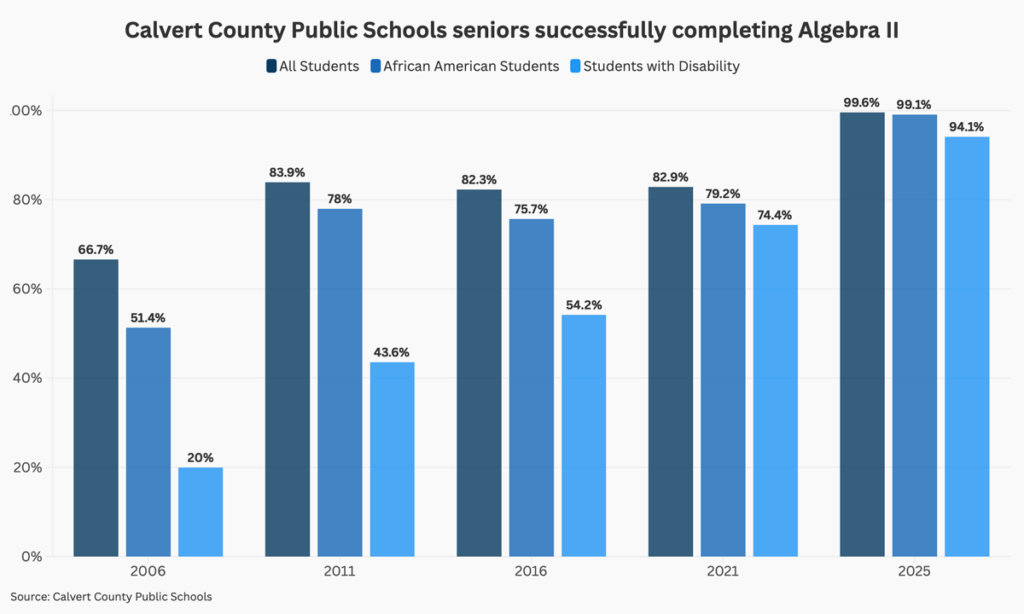
Calvert County Public Schools in Maryland eliminated lower-level math courses one by one between 2013 and 2021. School leaders at the 15,000-school district realized that while classes like pre-algebra and business math give students more time to master basic accomplishments, students could not take higher-level math classes. In the past decade, almost 100% of students completed Algebra II in 2025 compared to 67% of students in 2006. The effect was even larger for Black students and students with disabilities, with 99% and 94% of students successfully completing the course compared to 51% and 20% in 2006, respectively. With the curriculum changes, teachers were supported through professional development initiatives. Students also received more tutoring during lunch and after school. Schools across the country have been de-tracking classes (i.e., eliminating classes separated by academic ability) since the 1980s. Research has shown that mixed-level math classes increased attendance, the likelihood of staying at the same school all four years, and the opportunity to take college-level classes in high school.
Chalkbeat: Newark Gave 16-and 17-Year-Olds the Right to Vote Two Years Ago. They Are Still Learning Their Power.
Two years ago, Newark, New Jersey, was the first city in the state to allow 16- and 17-year-olds to vote in school board elections. In April, only 73 teens voted in their first school board election. Student organizers and activists are leading initiatives to encourage more students to exercise their voting rights. The Youth Power Action Summit brought together 50 students to discuss teen voting rights and civic participation. Alongside The Gem Project, a nonprofit focused on youth civic engagement, students also spent months canvassing, participating in civic education workshops, and running voter registration competitions. Student participants requested to work more with the nine board members who oversee the 41,000 students in the district, especially regarding policies around mental health and school facilities, though their proposals have been rejected. One student who just learned about the school board election shared, “…There’s so many things going on. [The city] is finally letting students vote for stuff… but people are not as involved as they should be.”