Enrollment in traditional public schools has been declining for almost a decade, spurred on by declining birth rates and an increase in school choice options. Although academic performance and, more recently, perceived alignment with family values have long shaped these choices, a growing body of research finds that non-academic factors now figure prominently in parents’ decisions to send their children to charter and private schools or opt for homeschooling.
This trend can have significant financial implications for some schools. In Massachusetts, for example, funding follows a student from a traditional public school to a charter school, leaving the public school with less money and the same fixed costs of operating a school. The impact on schools has become so considerable that some districts across the country have hired consulting firms to drum up interest in public schools.
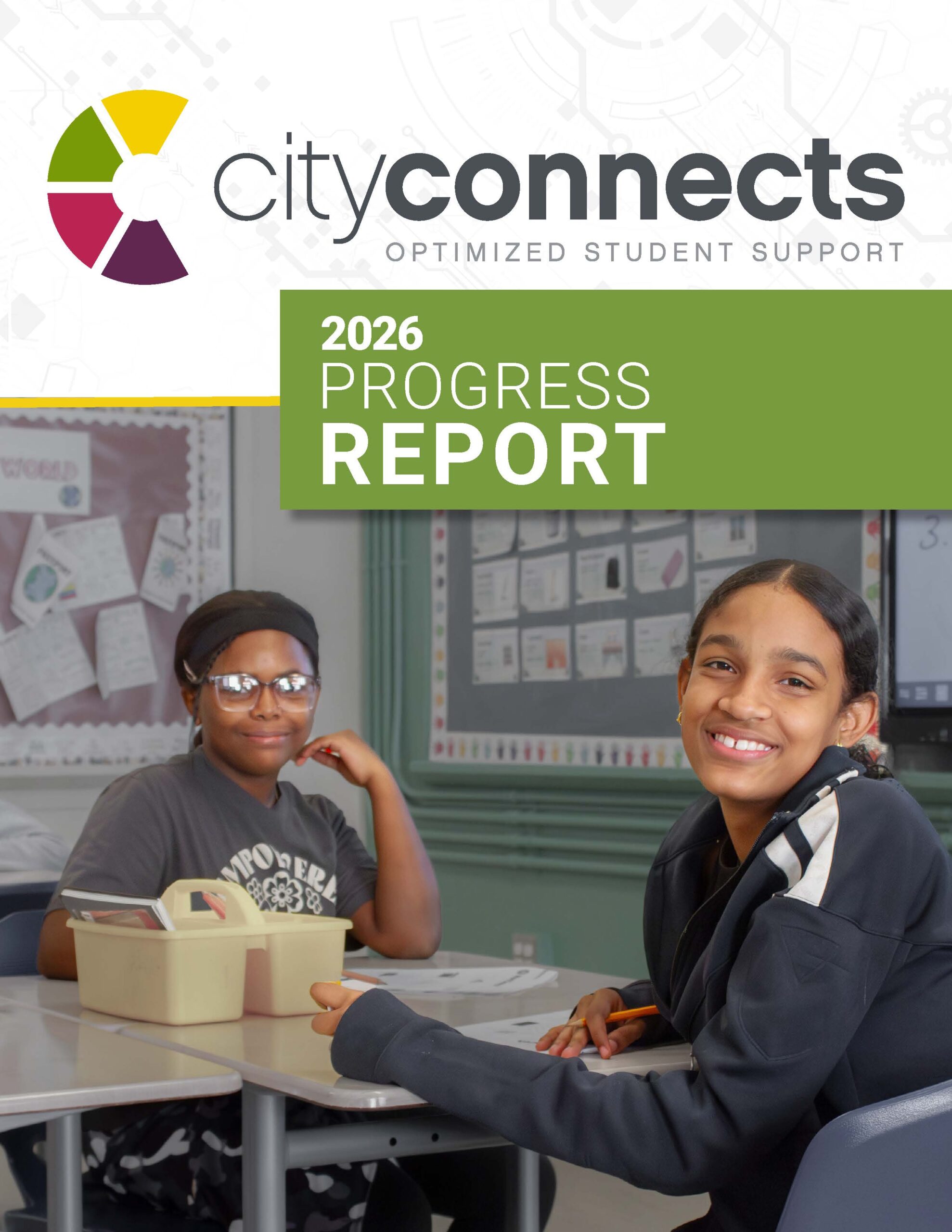
A new report from the Mary E. Walsh Center for Thriving Children explores another method for recruiting and retaining students: integrated student support. Researchers investigated the impact of City Connects—an evidence-based model of integrated student support that fosters the strengths and supports the needs of students and their families—on enrollment at traditional public schools.
“Parents just want the best for their kids. Imagine a parent of a student in a struggling school who is considering moving their child to a charter school. Then their public school gets a City Connects Coordinator and the kids are happier, doing more enrichment activities, and are more engaged. That parent is going to be more likely to keep their child at the school,” said Illia Polovnikov, Researcher at the Center for Thriving Children and the lead author of the report.
Illia’s report examines enrollment at nearly 2,000 Massachusetts public schools over two decades, analyzing the impact of 76 of those schools that adopted City Connects between 2007 and 2023. By comparing City Connects schools to schools with similar enrollment trajectories that did not adopt City Connects, researchers found that City Connects led to a 5-7% increase in enrollment. This translates to an average of 15 to 20 additional students per school.
“There is already a lot of evidence that with City Connects, math scores go up, ELA scores go up, high school graduation and attendance go up. People can sense that, it’s going to make them more attracted to the school and less likely to leave,” Illia said. “Emerging research is showing that parents are caring about a lot more than test scores as well—parents want their kids to be safe, they want them to have activities that maybe they can’t afford to do outside school. So when City Connects brings in all these services and gets kids engaged, it has a real value. City Connects actually changes the school and how parents and kids perceive the school.”
These results provide the first causal evidence that comprehensive student support programs can generate meaningful enrollment gains for traditional public schools—a shift that is economically meaningful. For a school enrolling 350 students, a 7% increase represents approximately 25 students, translating to roughly $225,000-$300,000 in preserved annual revenue in Massachusetts.
“City Connects not only impacts student outcomes, it is also going to save schools quite a bit of money in the long term. Because the reality is that students are leaving and eventually schools are going to lose funding and struggle even more,” Illia said.
Investing in City Connects not only affects the academic and non-academic outcomes of the students, it also makes sense financially.”
Check out the full progress report to learn more.