Here’s the new edition of The Weekly Connect. Check it out and sign up to have it delivered to your inbox!
Millions of U.S. students attend schools located near environmentally hazardous sites.
Governors’ 2026 priorities shift toward student nutrition, AI safety, and workforce development.
Indiana district turns to microschools to combat failing public school enrollment.
Research and Practice
Brookings: Helping Low-Income Families Access WIC and Free Early Childhood Education
Researchers from Brookings, the Louisiana Department of Health, and Tulane University assessed the impact of administrative burden (e.g., learning about programs or complying with requirements) on families applying to the Special Supplemental Nutrition Program for Women, Infants, and Children (WIC) and free early childhood education. Government officials in Louisiana piloted an application process to help families access SNAP and other public assistance programs. The researchers used a randomized controlled trial to assess the proposed system and divided respondents into three groups: the control group received the SNAP application; the information group received the application and were notified of other programs for which they were eligible; and the support group received all information and could apply to SNAP and other programs simultaneously. Twenty-nine percent of the control group, 37.9% of the information group, and 37% of the support group applied to WIC. The percentage of families actually enrolling in SNAP was minimal, suggesting that families still have difficulties in enrolling in government benefits even with additional support.
The 74: Millions of U.S. Students Attend Schools Near Environmentally Hazardous Sites
A new report from Brown University found that millions of U.S. students attend school near contaminated environmental sites. With data from over 75,000 pollution sites and public and private schools, the researchers found that over 10,000 schools are located within a quarter mile from a superfund site (historical contamination of soil and groundwater), brownfield (former industrial sites with contaminants), or a Toxic Release Inventory facility (active site that handles chemicals). Most high-need student groups are more likely to attend schools near a hazard site, including Native American, Black, Latino, English language learners, and low-income students. Urban schools are almost twice as likely as suburban or rural schools to be near a hazardous site. Private and public schools have the same likelihood of being in proximity to one. Exposure to these sites is linked to an increased risk of cancer, birth defects, and other negative health outcomes. There are currently no consistent guidelines for building schools near environmental hazard sites.
Policy
Chalkbeat: Indiana Lawmakers Pass Bill to Create Appointed Indianapolis Schools Board
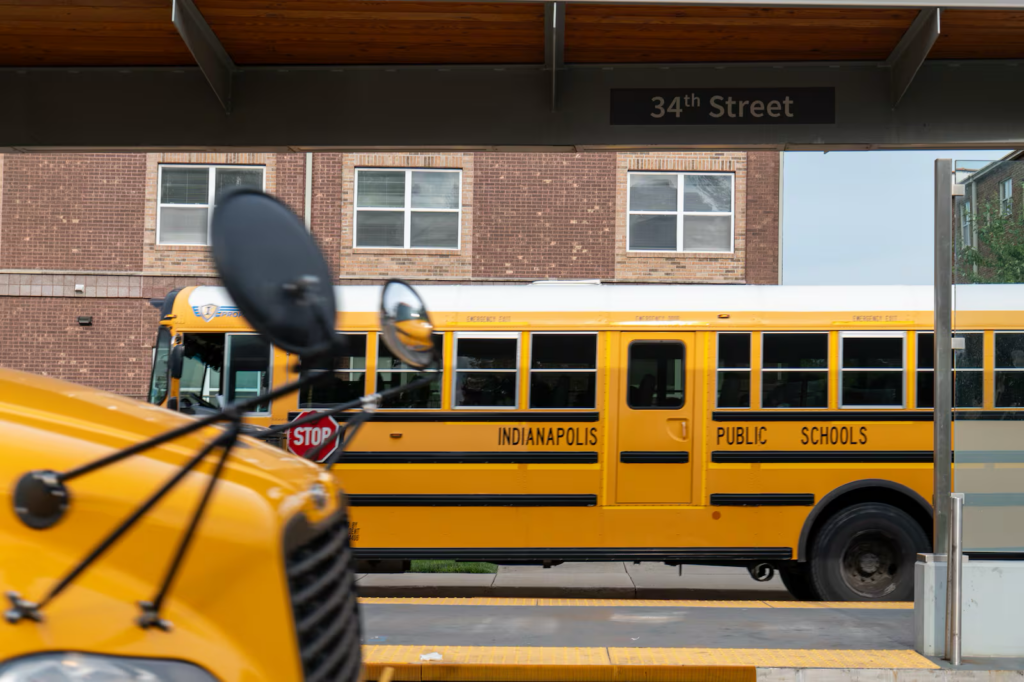
Indiana lawmakers passed a bill that changes the authority of public education leaders in Indianapolis. HB 1423 establishes the Indianapolis Public Education Corporation, a board appointed by the mayor, which creates new transportation plans and a system of accountability to determine when schools should close. The board would also manage facilities for public schools in the area, which schools can opt out of, as well as distribute property taxes for school operations. The bill also exempts Indianapolis Public Schools from the $1 law, which requires school corporations to sell underused or closed schools to charter schools for $1. The bill is praised by advocates for giving more resources to charter schools, including transportation aid. Those against the bill are concerned about the reduction of the Indianapolis Public School board’s authority on education matters. The bill was sent to Governor Mike Braun, and the Indianapolis mayor will appoint members of the corporation board by March 31.
The 74: Student Nutrition and School Meals a New Focus for Nation’s Governors in 2026
FutureEd analyzed speeches from 39 governors to identify common themes in their priorities, including conversations on school choice, workforce development, early learning/child care, and student health and nutrition. Fifteen governors highlighted the importance of developing career and technical education programs to align with the changing job market in fields such as health care, education, and technology. Both Democrats and Republicans talked about expanding early child care and learning programs to increase access for working parents, as well as commitments to universal pre-K programs. Last year, school phone bans were proposed to support and improve children’s mental health. While school phone bans still aim to mitigate this issue, this year, many governors’ rationale for legislation focuses on improving student learning as well as online safety, especially regarding AI chatbots. With a federal focus on children’s nutrition and health through the Make America Healthy Again initiative, governors followed suit and mentioned priorities in expanding free and reduced school meal access and removing artificial dyes and processed foods from school lunches.
See also: ‘Hungry Kids Are Not Going to Learn’: See How These Students Benefit From Universal School Breakfast
Around the Nation

EdSurge: With Teens Comfortable Confiding in AI, Should Schools Embrace It for Mental Health Care?
Some schools have begun to use AI programs, like Alongside, an automated student monitoring system, to support children’s mental health needs. With this service, students message an AI llama named Kiwi about their problems and work together to build resilience. Clinicians monitor the AI-generated content, and school counselors receive alerts if the app suspects that a child might be at risk of harming themselves or others. The tool helps a counselor in her rural school district in Putnam County, Florida, put out “small fires,” so she has more capacity to serve students needing more support. The chatbot may also be more approachable for students who are hesitant to talk to a counselor about their needs. As AI has become more relevant in school settings in the past year, educators and families continue to be concerned about schools’ overreliance on AI and its impact on students’ relationships and privacy.
See also: The Lesson of A.I. Literacy Class: Don’t Let the Chatbot Think for You
The Hechinger Report: Are Microschools a Solution to Falling Public School Enrollment? One District Thinks So
Nature’s Gift in Greenfield, Indiana, is a microschool: an environment that offers flexible learning opportunities for a small group of students. Since the pandemic, families have become increasingly interested in and are enrolling in microschools. While microschools are typically private, the superintendent of Eastern Hancock Community Schools in Charlottesville, Indiana, wanted to explore options for his rural district. The schools were struggling financially, and many families withdrew their children from the district to enroll them in non-traditional settings. The superintendent gained approval from the state’s charter school board to create the Indiana Microschool Collaborative. Nature’s Gift has fifty students and is located at a 12-acre youth camp. Students manage their daily schedules and advance in the school by showing ability or interest in certain areas, not by grade level, test scores, or age. As microschool options continue to grow, supporters of the movement are concerned that they will lose their individuality and instead have to cater to state requirements and assessments.
The 74: How Pittsburgh Is Promoting Intergenerational Play to Support Early Learning
A Pennsylvania pilot grant program, Let’s Play PGH!, provides funding for local organizations to create playful experiences for children and adults. The grant program began in 2023 to bring organizations together to create installations. Since then, $1.5 million in funding has been granted to organizations that are incorporating developmental research, urban design, and the science of play. The Firefly Garden in suburban Pittsburgh aims to foster intergenerational play and joint exploration. The play spaces are informed by community feedback; a program director for the space shared, “When we are building anything, we know that the community is going to end up being the user. Those are the experts.” The director of education of another Pittsburgh program found that after the first round of play testing, adults observed their children playing, rather than joining in. Once the team added play prompts, like instructions to play a game of hide and seek, around the park, adults started to play too.